Magma-Hydrothermal Research at Virginia Tech
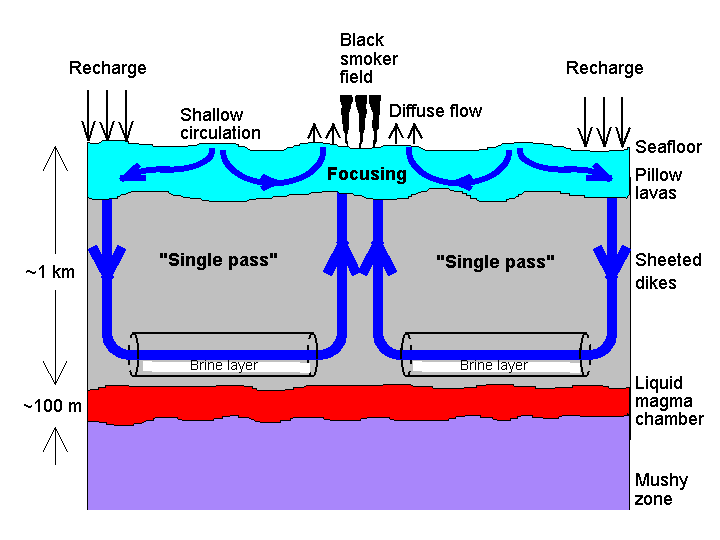

Research on magma-hydrothermal processes has been an integral part of my research since I originally joined the faculty at Georgia Tech in 1971 and has continued since moving to Virginia Tech in 2006, The program focuses mainly on the development of analytical solutions and numerical simulations that address fundamental processes in seafloor hydrothermal systems, and related magmatic processes. In addition to the modeling work, however, we have undertaken laboratory experiments in fractured ultramafic rocks, and have made advective heat flow measurements at ocean ridges. Also of interest are volcano-hydrothermal processes at magmatic arcs, and the role of hydrothermal heat transfer on deep ocean circulation
Early research on seafloor hydrothermal systems addressed the role of hydrothermal circulation in causing conductive heat flow anomalies on the seafloor. More recent work has addressed: (1) the characterization of high temperature systems at ocean ridge crests (black smokers), (2) heat transfer across the magma-hydrothermal boundary layer, (3) the role of thermoelastic stresses and mineral precipitation on the evolution of permeability, (4) the formation of event plumes, (5) the relationships between focused and diffuse venting, (6) the role of serpentinization reactions in driving hydrothermal circulation and affecting crustal deformation, (7) two-phase flow and phase separation, (8) hydrothermal processes in the Archean, and (9) modeling of hydrothermal processes on Europa, Mars, and elsewhere in the solar system.
Early work on magmatic processes included studies of double diffusive convection during magma generation and crystallization and phreatic eruption mechanisms. Current research on magmatic processes is primarily concerned with (1) models of dike emplacement and the connection between diking, seismicity and hydrothermal circulation, (2) models that link magma convection, crystallization and replenishment to hydrothermal heat output, and (3) magma unrest and magma-hydrothermal processes at arc volcanoes.
The magma-hydrothermal research program at Virginia Tech is lead by Dr. Robert P. Lowell(full CV), Research Professor, Department of Geosciences �
Key Research Collaborators:
Dr. Leonid Germanovich, Georgia Institute of Technology; Dr. Kayla Lewis, Monmouth University; Dr. Karen Bemis, Rutgers University; Dr. Laruent Montesi, U. of Maryland; Dr. Pavithra Sekhar, U. of Mary Washington; Drs. David Lockner and Diane Moore, USGS Menlo Park
Current Graduate Students:
Kannikha Kolandaivelu, Liang Han
Current Undergraduate Student:
Christyn Garber
Recent Graduates:
Aida Farough, Ph.D.� (2015); Shreya Singh, Ph.D. (2015); Kate Craft, Ph.D. (2013); Jaewoon Choi, M.S. 2013; David Mercier, M.S. 2013
FISHES Source Code and Documentation
FISHES (Fully Implicit Seafloor Hydrothermal Event Simulator) is a control volume code for studying two-phase flow and phase separation in the NaCl-H2O hydrothermal system. Equations of state for the system over the P-T range of 85-1000 bars and 0- 800�C are currently implemented Currently the code operates in 1 and 2-D spatial geometries. For further information contact Dr. Kayla Lewis (Lewis, Kayla <klewis@monmouth.edu>). To download FISHES and the user's guide you may use the link: http://www.geophys.geos.vt.edu/rlowell/kaylal/ and click on downloads. The code and user's guide will be updated periodically. Look for information under News.
Some
Projects Planned and Currently Underway
- Two-phase flow in NaCl-H2O hydrothermal systems and phase separation in seafloor hydrothermal systems
- Serpentinization of peridotite and deformation at ocean ridges
- Modeling convection, crystallization, and replenishment of magmas beneath oceanic spreading centers
- Advective heat flow and modeling hydrothermal processes at the Main Endeavour Field, Juan de Fuca Ridge and EPR 9�50�N
- Diffuse flow circulation and its interactions with biological ecosystems
- Modeling mineral precipitation/dissolution (anhydrite and quartz) in seafloor hydrothermal systems
- Modeling volcanic unrest events and volcano-hydrothermal systems in arc settings.