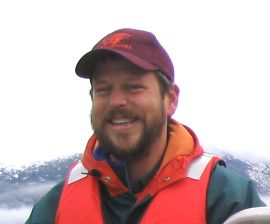
John A. Hole

RESEARCH INTERESTS: EXPLORATION SEISMOLOGY OF THE CONTINENTAL CRUST
My research interests are
- the application of reflection and refraction seismology
to the study of Earth's crust, and
- the development and implementation of improved and practical
seismic acquisition and analysis techniques.
My research emphasis is on the acquisition and analysis of
seismic reflection and seismic refraction data and
their interpretation in terms of geological structure, composition,
evolution, and tectonics. Applications include tectonics,
resource exploration (petroleum, mining, groundwater),
natural hazard assessment, geotechnical evaluation,
and environmental studies.
Working with real data stimulates my research interest in the
development of improved field and analysis procedures, extending
traditional seismic methods to solve geologic problems in new ways.
Methods of interest include three-dimensional traveltime inversion,
full-wavefield inversion, prestack depth migration, and
seismic guided waves.
Current projects include:
- Field Projects and Subsequent Data Analysis
- seismic reflection and refraction investigation of the
rifting of continental lithosphere in the Salton Trough,
southern California, and earthquake hazards of the adjacent
San Andreas Fault (field work winter 2009-10)
- seismic refraction and reflection study of the
Coast Mountains Batholith of British Columbia, investigating
magmatic reworking of the continental crust (field work 2008)
- seismic refraction and reflection studies of crater collapse
mechanisms at the 35 Ma 85-km wide
Chesapeake Bay impact crater (field work 2002, 2004)
- seismic reflection and refraction studies of the
San Andreas Fault near Parkfield CA, at the site that
EarthScope's project
SAFOD is drilling through the fault (field work 1998, 2003)
- Technical Studies (synthetic and/or real data)
- imaging the internal properties of major active fault zones using
seismic guided waves (application to borehole data from San Andreas Fault)
- seismic characterization of induced fractures in hydrocarbon reservoirs
(application to industry microseismicity dataset)
- wavefield inversion (aka diffraction tomography) of wide-angle
refraction and reflection data (application to San Andreas Fault,
Chesapeake Bay, and Salton Trough datasets listed above)
- resolution of travel time and waveform inversion
TEACHING
Graduate Students and Research Associates
I am looking for good graduate students.
Please contact me if interested.
Courses Taught
I am the undergraduate academic advisor for students registered
in the BS Geosciences - Geophysics Option.
RESEARCH FACILITIES
The geophysics group consists of several professors:
Martin Chapman,
John Hole,
Scott King,
Bob Lowell,
Arthur Snoke,
Chester Weiss,
Ying Zhou.
The geophysics group maintains a network of Linux and Mac OSX
workstations, and >20 Terabytes of disk space. Seismology and
Geodynamics operate a Linux cluster with 96x8-core servers.
We have two Unix/Linux system administrators on full-time staff.
The Virginia Tech
Terrascale Computing Facility
operates two clusters that are being used for geophysical research:
a 128-cpu, 320-Gbyte RAM, SGI Altix 3700 shared-memory machine running Linux;
and a 2200-cpu Apple Xserve cluster running Mac OSX (switching soon to Linux).
Major commercial software licences include
Landmark's
suite for 3D seismic processsing (Promax) and seismic & stratigraphic interpretation, and
ESRI's Geographical Information System (GIS).
Seismic software developed in-house involves 3-D modeling and inversion of times and waveforms.
Exploration geophysics field equipment includes:
- Geometrics Strataview 60-channel, 24-bit seismic recording system, geophones and cables.
- Sensors and Software Pulse-Echo 100 ground-penetrating radar (12.5 - 200 MHz).
- AGI SuperSting 8-channel, 64-electrode electrical resistivity
- Campus 25-electrode electrical resistivity.
- Scintrex ENVI VLF electromagnetics with resistivity.
- Lacoste-Romberg gravimeter, with limited microgravimetry hardware.
- Trimble real-time kinematic GPS surveying equipment (cm accuracy).
Department of Geosciences
Virginia Tech
4044 Derring Hall (MC 0420)
Blacksburg, VA 24061
phone: 1-540-231-3858
fax: 1-540-231-3386
office: 1040 Derring Hall
e-mail: hole@vt.edu
last updated February 2008
To My Home Page
To Geosciences Home Page